How to Balance Transactional and Relational Leadership

Overview
Leaders often struggle with integrating both transactional and relational leadership into their day-to-day work.
Assumptions, being “in the box,” and collusion create cycles that pull leaders into reactive, transactional patterns.
Strong leadership comes from shifting into curiosity, balancing clarity with connection, and viewing colleagues as complex humans instead of objects.
Leaders, how often are you leading transactionally rather than relationally?
I’ll give you a hint. If your interactions look more like a back-and-forth information exchange, you might be focusing solely on the tasks at hand rather than relating to your team.
Relational leadership is essential for understanding your team members’ position and orientation towards the work so projects can move forward successfully.
"It's not about asking, 'How are you?' but rather, 'What's happening for this leader and how do we solve it together?'"
The most successful leaders don’t choose between transactional vs. relational leadership. Instead they masterfully toggle between the two approaches based on the context.
Read on to learn:
How to determine when to use relational vs. transactional leadership
Common traps that keep leaders stuck in unproductive, transactional cycles, including being “in the box" and "collusion"
How to overcome barriers and build in more relational leadership approaches that strengthen your relationships and build trust
How Leaders Get Stuck in Transactional Patterns
In our client work, we sometimes see a cyclical dynamic arise when leaders become stuck in their own assumptions rather than relating to their team.
It's called collusion, and it occurs when two leaders begin operating from assumptions about each other rather than relationally seeing the actual humans and reality behind the situation.
I’ll give you a hypothetical scenario:
>A teammate isn’t sharing information with you.
>You assume they're not being collaborative, so you start emphasizing transparency and peppering them with questions.
>Your teammate experiences your questions as pushy, demanding, or overwhelming, causing them to delay responding or avoid some of your questions altogether.
>You interpret their delayed response as further evidence that they're being resistant or uncollaborative.
The cycle continues, often without either leader realizing they're helping create it.
To break the cycle, leaders must step back, get curious, and reconnect with the human being behind the behavior.
What Traps Leaders in Transactional Leadership? Understanding being “In the Box"
A useful way to understand why leaders get stuck in transactional leadership patterns is the “being in the box” analogy which comes from the book Leadership and Self-Deception by the Arbinger Institute. The concept can also be learned about in this YouTube video.
Essentially "being in the box" is a form of self-deception where we stop seeing our team members clearly.
When we’re in the box, we reduce others to labels:
The employee becomes "the uncollaborative and defiant teammate”
The manager becomes "the micromanager”
The client becomes "the problem”
Once those stories take hold, we justify our own behavior, blame others, and lose sight of our own role in creating problems.
This is also where collusion shows up, like in the hypothetical story I demonstrated for you earlier.
When two or more people are both “in the box” and operating from assumptions, they unknowingly reinforce each other’s behavior and keep the cycle going.
Instead of thinking relationally and asking, “What’s happening for this person?” the question becomes transactional and asks, “How do I get them to do what I need?”
Getting out of the box starts with leaders seeing their colleagues as complex humans again rather than transactional objects.
Tips for Balancing Transactional and Relational Leadership
1. Discern when to use transactional leadership vs relational leadership
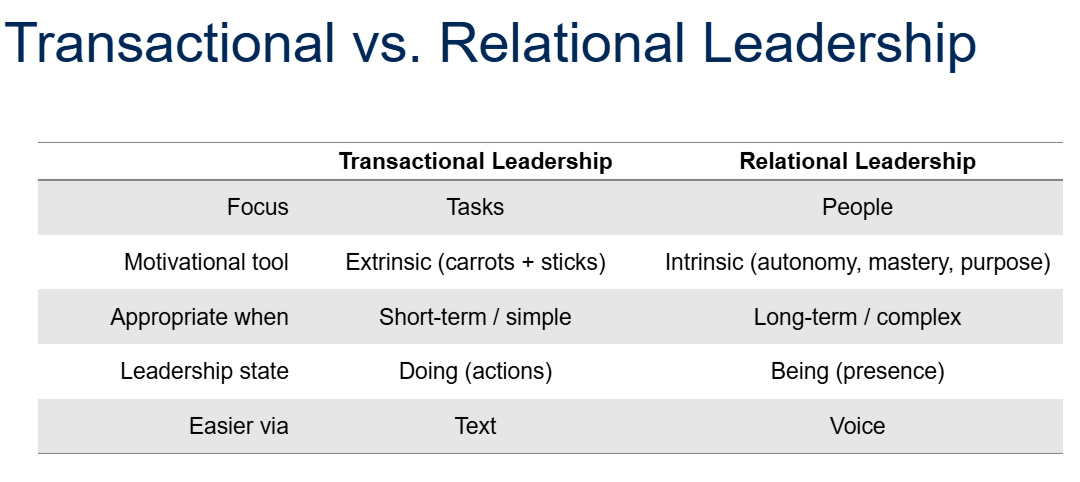
Rather than the two leadership styles requiring a 50/50 balance, it really comes down to what each situation requires.
Use transactional leadership when the work is:
Fast, simple, or time-sensitive
Task-based (“send this,” “confirm that,” “update me”)
Execution-heavy (logistics, deadlines, coordination)
Use relational leadership when the work is:
Complex or long-term
Requires trust, alignment, or problem-solving
Involves miscommunication or tension
Quick rule of thumb to keep in mind:
Transactional = doing
Relational = understanding
2. Understand what often drives transactional leadership
Be aware of common scenarios that lead to more transactional leadership:
Time pressure > defaulting to speed over understanding
Assumptions > filling in the story instead of asking questions
Low trust / vulnerability > avoiding deeper conversations
3. Build more relational leadership approaches
Small shifts make a big difference:
Use people’s names to signal you value them
Ask open questions such as “what’s going on for you?”
Get curious before making assumptions
Build relational leadership into systems and meetings rather than just asking for status updates
Conclusion
Great leadership is knowing how to move between both transactional and relational leadership.
Transactional leadership involves focusing on what tasks need to get done, while relational leadership focuses on human complexity and what your teammate is experiencing.
Under pressure, it’s easy to default to tasks, assumptions, and quick fixes. But stronger leadership comes from noticing when you’ve slipped too far into a transactional leadership pattern and intentionally moving back towards curiosity and connection.
As you go about your day as a leader be aware of what mode of leadership you’re in and if it’s the best choice for the present context.
If you want to work on better balancing transactional and relationship leadership, leadership coaching can help.