
Overview
Many leaders struggle with the belief that they must choose between being clear and being nice.
Strong leadership comes from integrating both high standards and human understanding in the same conversation.
Using simple models (like courage & compassion) helps leaders maintain accountability while preserving trust and relationships.
Not once, but twice lately, clients have asked me, “how do I hold the line without being perceived as an arrogant asshole?” It’s a common struggle many leaders have, and one you can likely relate to.
There’s an ongoing misconception that managers and team leaders must be either clear and assertive or friendly and warm.
I’m here to tell you the two aren’t mutually exclusive. You can in fact be both clear and kind as a leader. It’s actually an essential balance to strike if you want to inspire the best from others and achieve results as a team.
Read on to learn how two leaders are currently grappling with this, and discover a strategic model you can use to balance being both clear and kind as a leader.
Two Different Leaders and a Shared Leadership Challenge
“You can be warm and clear at the same time.”
Recently, two clients faced a similar leadership challenge: how to hold people accountable and have difficult conversations without damaging relationships or sacrificing empathy and trust.
The first was a CEO dealing with a vendor whose faulty equipment was costing his company thousands of dollars each month. He needed the vendor to step up and take strong, immediate action, but couldn’t afford to damage the long-term partnership. This leader decided to harness his courage and say to the vendor: “Here’s what I need from you, and here’s why. What do you need from me in order to do this?”
The second was a senior leader known for holding high standards. He cared deeply about accountability but worried that enforcing expectations would cause others to see him as a jerk. This leader decided to bring gratitude, acknowledgement of his team’s strengths and more genuine connection into the conversations where he discussed standards of excellence.
In both cases, the shift required moving out of an either/or mindset and into a both/and approach: clear expectations and empathy.
We worked on how to name the issue directly while staying grounded in respect, so the conversation held the standard without losing the relationship.
Instead of choosing between clarity and compassion, these leaders started to see how to integrate both into the conversation. That shift changed not just what they said, but how they showed up as leaders.
A Model for Balancing Clear and Empathetic Leadership
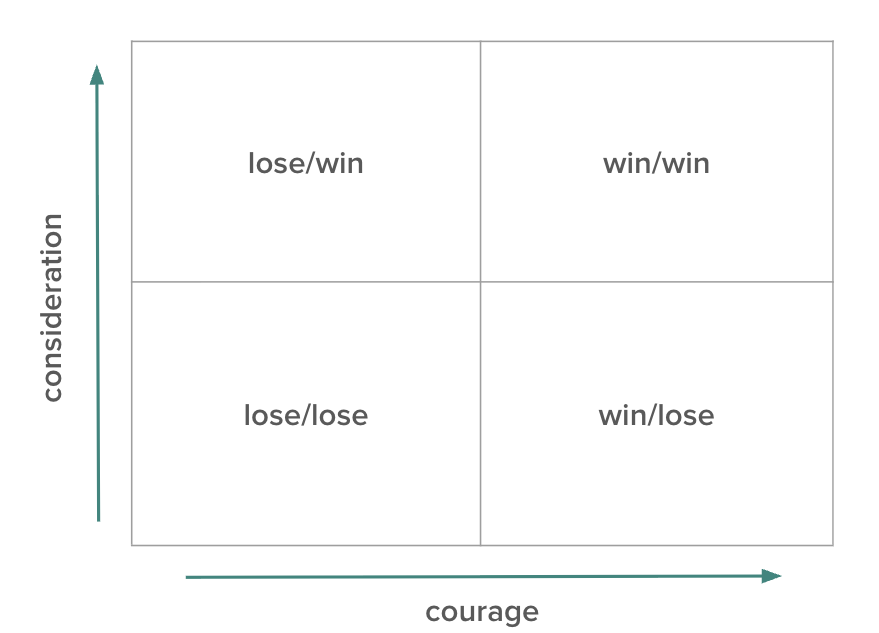
Source: The 7 Habits of Highly Effective People by Stephen Covey
Win–Win Leadership: Being Both Courageous and Compassionate
One way to look at being both clear and kind is through the leadership qualities of courage and compassion.
Courage: saying what needs to be said
Compassion: staying connected while you say it
The goal is to be in the upper-right quadrant: high courage, high compassion.
This is win-win leadership.
For example: “This isn’t meeting the standard, and we need to address it,”and, “I understand what’s going on, and I want to support you.”
Both can live in the same conversation and lead to a win-win.
Exercise: Practice Being Clear and Kind
Try this in your next 1-on-1 or team conversation. Pick a situation where something didn’t meet expectations.
Then use this simple 3-step structure:
1. Name the issue clearly
“This didn’t meet the standard we agreed on.”
2. Add empathy or curiosity
“Can you walk me through what was going on?”
3. Move toward support and next steps
“What would help you meet this going forward?”
You’re not lowering expectations—you’re holding them in a way that keeps the conversation open, honest, and productive.
Conclusion
As leaders you don’t need to choose between being kind and being clear. Effective leadership isn’t an either/or proposition.
You can:
communicate high standards while also communicating empathy
acknowledge someone’s circumstances without lowering expectations
be warm and direct in the same conversation
In fact, the most effective leaders stop trying to choose and instead integrate the two.
If you’re navigating difficult conversations and struggling to balance clarity with empathy, leadership coaching can help.