
Lately, time management has been coming up for the leaders we work with.
Many of these leaders describe feeling busy, reactive, or stretched too thin—like there’s never quite enough time in the day to get to the work that actually matters.
But often the issue isn’t the lack of time itself. It’s that one (or more) of the three essential components of time management is missing.
When that happens, things start to break down. We lose focus, get pulled into non-urgent or reactive tasks, and end up feeling constantly behind.
Let’s unpack how to navigate time more effectively as leaders and avoid some of the common time management pitfalls.
How to Better Approach Time Management as a Leader
To get a handle on managing our time, three essential components need to be worked on, starting with a conscious awareness of how you’re spending your time.
1. Prioritization (Choosing the Direction)
The first component of time management is prioritization—making a clear choice on what to actually work on.
A helpful tool for building awareness is the Eisenhower Matrix developed by Dwight D. Eisenhower, which helps us consciously see how we’re spending our time and what category our tasks fall into. Author Stephen Covey expands on this concept with his own Time Management Matrix explained below.
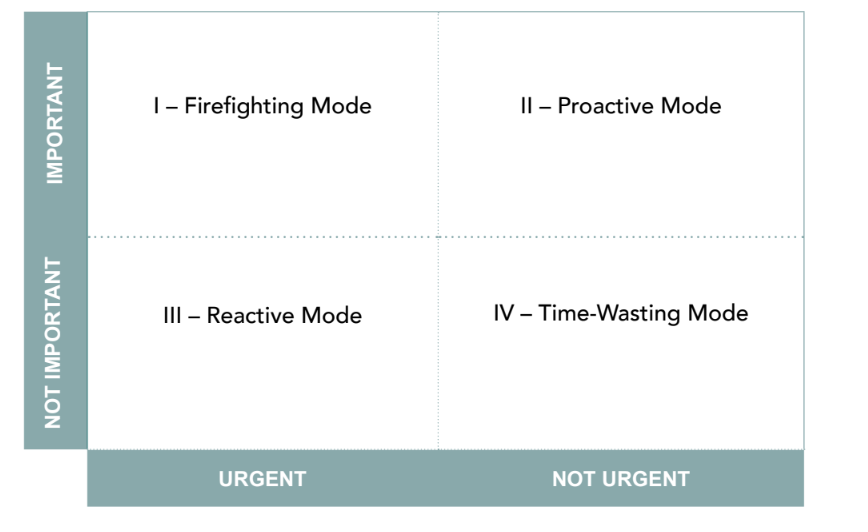
(Time Management Matrix Source: The Seven Habits of Highly Effective People by Stephen Covey)
Quadrant 1 “The Firefighting” Zone: tasks that demand our immediate attention because they are both urgent and important. The problem with spending too much of our time “firefighting” is that it can lead to misalignment on the team and burnout. Leaders can use proactive thinking to prevent a lot of these firefighting tasks before they occur.
Quadrant 2 “The Proactive” Zone: important, but non-urgent tasks such as big-picture thinking and planning. It’s important to consciously schedule these into our day and protect this time.
Quadrant 3 “The Reactive” Zone: day-to-day interruptions that don’t move our long-term goals forward and could be delegated to another member of our team.
Quadrant 4 “The Time-Wasting” Zone: unnecessary distractions such as doom-scrolling which signals we actually need a break. There are better ways to recharge and restore your energy so stepping away isn’t a waste of time.
One of the most challenging aspects of prioritization is competing priorities - when two or more tasks have equal importance. In those cases, it’s ok to arbitrarily decide which one to complete first. The goal here is to make a clear choice on where to put your focus next.
2. Focus & Boundaries (Staying the Course)
The second component of time management is focus, which requires commitment and boundaries. It means truly committing to the tasks you’ve chosen and setting the boundaries needed to get them done.
Maybe your boundary is mental – choosing to compartmentalize and think about only the task on-hand. Or maybe the boundary is physical – shutting your office door so others don’t walk in and interrupt you mid-task.
3. Energy (Knowing What You Can Handle)
The third component of time management is energy management, which invovles understanding your capacity in the moment.
We tend to think about our day as one continuous block of productivity, but in reality, our energy moves in cycles.
A helpful way to think about managing our energy is through perform and recover cycles.
Every 80-90 minutes or so, most people need some form of energy reset:
a mental shift away from focused work
movement
hydration or food
This cycle isn’t a distraction from productivity—it’s an investment in your next focused session and what makes productivity sustainable.
Recap: How to Maximize Your Time as a Leader
Time management isn’t about doing more, it’s about being intentional with your choices in navigating time.
Start with awareness. Use the Time Management Matrix to determine where your time is being spent. See if you can get more time in the Proactive Zone.
Choose your focus, then commit to it with clear boundaries.
Work with your energy needs and cycles, not against them, to sustain performance.
Want to dive deeper into time management? Download our free time management workbook.